This page is complemented by:
Gluten-free diet: what to know (part 1)
Celiac disease: labeling, legislation and the 20 ppm limit (part 2)
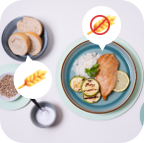
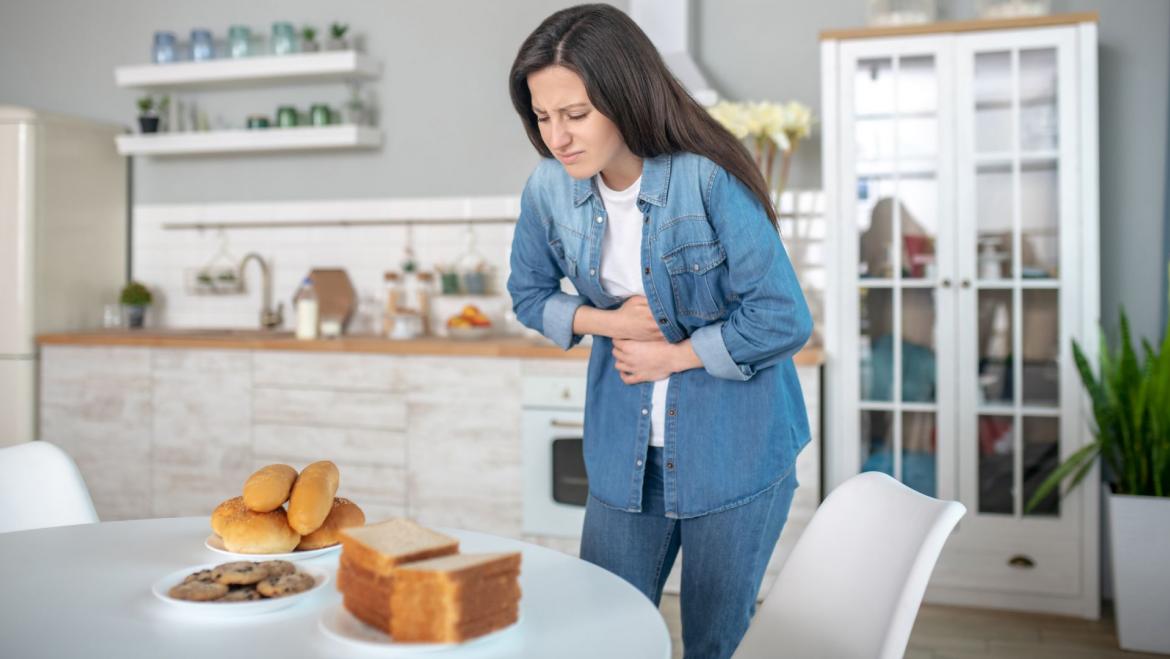
Cross-contamination with gluten occurs when a product, food, utensil, or surface containing gluten comes into contact (even minimally) with a gluten-free product, food, utensil, or surface, or one intended for use by someone with celiac disease, causing contamination. When this happens, the food becomes unsuitable for people with celiac disease. This contact can occur in various situations, such as:
- During shopping: when gluten-free foods are stored in bags or containers that previously contained gluten-containing foods, causing the transfer of gluten particles.
- Storage: when we place gluten-free foods mixed with open or unpackaged gluten-containing foods.
- Shared kitchen: when kitchen utensils (pots, pans, cutting utensils, oven, etc.) that have been in contact with foods containing gluten are used to prepare gluten-free foods.
- Food handling: when people handling gluten-free food touch gluten-containing food without washing their hands with soap and water, or when gluten-free food is handled on surfaces that have been in contact with gluten. When unpackaged gluten-containing products come into contact with gluten-free products.
Serving in restaurants or food establishments: when gluten-free foods are prepared or served in places where gluten-containing foods are also handled.
It is essential to avoid it throughout the entire process, from the shopping basket, at home, at family meals and in restaurants.
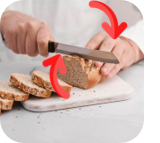
Cross-contamination of gluten is a problem for people with celiac disease, since even small amounts of gluten can trigger intestinal damage, even without symptoms. It is important to avoid cross-contamination of gluten to ensure the safety of gluten-free foods throughout the entire process, from purchase to consumption.
It's important to note that whenever we talk about contact, we're referring to both direct and indirect contact with the product itself. In other words, there's no cross-contamination if a packaged product containing gluten comes into contact with a packaged gluten-free product, but there would be cross-contamination if we touch gluten with a utensil or our hands and then touch the gluten-free product.

Kitchen utensils: wooden utensils can retain traces of gluten due to their porous nature. It is recommended to remove wooden utensils used with gluten-containing foods. To prepare gluten-free foods, use plastic or wooden utensils dedicated exclusively to gluten-free food. Metal utensils can be used if thoroughly washed.

Special attention should be paid to cutting boards, spoons, and other utensils that can retain food residue.
The pasta strainer should be replaced if it has previously been used to drain pasta containing gluten and is difficult to clean, especially if it has small holes. The new strainer should be used exclusively for gluten-free foods.
Do not reuse cooking water, frying oil, or broths that have been used to prepare foods containing gluten.
These changes adapt the website content to the guidelines in the reference PDF on household appliances, utensils, oven, air fryer, and strainers.
Household appliances:

-
The toaster, fryer, and pasta maker must be used exclusively for gluten-free food.
-
If these appliances have already been used to cook food containing gluten, they should not be used again to prepare gluten-free food, as they may be contaminated.
-
If the sandwich maker is detachable and for shared use, it is necessary to wash it very well after each use.
-
Do not use the fan setting in the oven. If baking gluten-containing and gluten-free foods together, the gluten-free food should be cooked in a covered container and placed on the top rack of the oven.
-
In the air fryer, completely wrap the food before cooking.
-
In the microwave, heat the food with a clean lid or the lid of a container.
-
The barbecue grill and tongs should be used exclusively for gluten-free food. If gluten-containing foods have been grilled or bread toasted, it is recommended not to use them.
-
Disposable bags can also be used to prepare gluten-free toast or pizzas in a toaster or oven that has previously been used with gluten. There are also specific bags available for barbecue grills.

When choosing products it's important to classify them as generic, conventional, specific, and unsuitable. Shop following the decision tree: everything gluten-free and, whenever possible, healthy unprocessed foods . If in doubt, scan the barcode with the Catalan Celiac Association app or ask FACE (the Catalan Federation of Celiac Associations), but don't consume the product until you receive confirmation that it's suitable.
Doubling up on foods that are easily contaminated during daily use. Spreads should be exclusively for people with celiac disease, as they are easily contaminated. Examples include butter, jam, hummus, guacamole, etc. If someone uses butter on bread containing gluten and then dips a knife with bread residue into the butter to spread more, the butter will be contaminated because there has been direct contact with gluten. These spreads can be purchased in individual portions, or everyone can serve themselves directly onto their plate instead of taking them from the container.
When making a purchase:
- Always read food labels to check for gluten or gluten-containing ingredients. Avoid unpackaged (bulk) or unlabeled artisanal products if you don't know their exact composition.
- Ingredients that contain or may contain gluten: gluten, cereals, flour, starches, flour, fiber, thickeners, semolina, vegetable protein, protein hydrolysate, malt, baking powder, modified starches (E-1404, E-1410, E-1412, E-1413, E-1414, E-1420, E-1422, E-1440, E-1442, E-1450).
- Gluten is a compound with many properties, which is why it's widely used in the food industry. Look for the "spike logo", which indicates gluten-free products and foods.
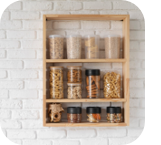
Once the diagnosis has been done, always try to identify a cupboard for storing gluten-free food. It's not necessary to have a separate kitchen for preparing gluten-free products, although a dedicated area makes the process easier by preventing cross-contamination. These dedicated cupboards and surfaces will be thoroughly cleaned the first time, and no food or products containing gluten will ever be placed there again.
Avoid the presence of flour and breadcrumbs in the kitchen because they are very volatile products and can easily contaminate work areas.
How to save your purchase
- Keep gluten-free ingredients or foods separate from the rest.
- Store gluten-free products in the upper part of the cupboards so that if springs fall, they will fall on the products containing gluten, reducing the risk.
- It's helpful to identify them with some kind of label , sticker, packaging, etc. This is essential if the gluten-free and gluten-containing products can be similar.
- Once the original product packaging is opened, it is recommended to transfer the contents to an airtight container. Label the container clearly and easily identifiable.

Choose gluten-free products, i.e., generic products; products that are on the FACE Food List, certified with the Crossed Grain symbol or with the "Controlled by FACE" Guarantee Mark or that have the gluten-free label.
Wash your hands with soap and water. Also, clean the counter or surface before you start cooking. Clean = gluten-free. Make sure all utensils and appliances you plan to use are clean. Utensils should not be porous (like wood) or have holes or crevices where food residue can accumulate.
It is recommended to use a dedicated plastic cutting board.
Gluten-free dishes should be prepared before the rest. Try to avoid cooking a gluten-containing dish and a gluten-free dish at the same time, because you can unintentionally cross-contaminate the gluten-free dish with the same utensils. For example, if you use the same spoon to stir two dishes, the gluten-free dish will become contaminated.
The oil and water used for baking must be clean. The same oil should not be used for cooking gluten-free and gluten-containing products. It is recommended to use a salt shaker with a dispenser, rather than a hand-held shaker, as these have a higher risk of cross-contamination.
Once the gluten-free dish is cooked, it must be protected with a lid to prevent anything containing gluten from falling into it until it is time to eat it.

It's recommended to keep gluten as far away from gluten-free options as possible. Food with and without gluten should not be on the same plate, as separating them once contact has occurred is ineffective. For example, if someone brings you a sandwich with bread containing gluten and an omelet inside, you can't eat that omelet because, even if it's not visible, it has been contaminated with gluten.
Each dish has its own cutlery and, when serving, the other dishes are not touched.
It's important to be mindful of where gluten-containing bread is placed on a table. Neither the bread basket nor any plate containing gluten should be placed over a gluten-free plate. For example: Someone passes wheat bread over the plate of a person with celiac disease to give it to someone who does eat gluten. It's possible that breadcrumbs have already fallen onto the celiac's plate, contaminating the entire plate and triggering an immune response.
Cut bread with gluten away from the table, do not scatter bread slices on the table.
No one should use their own cutlery on shared dishes. If tapas or dishes are being shared, it's recommended that the person with celiac disease serve themselves what they want from each option first. They should put it on their own plate and then not go back to the shared dishes to get more food, as cross-contamination is likely if there are gluten-containing options on the same table.

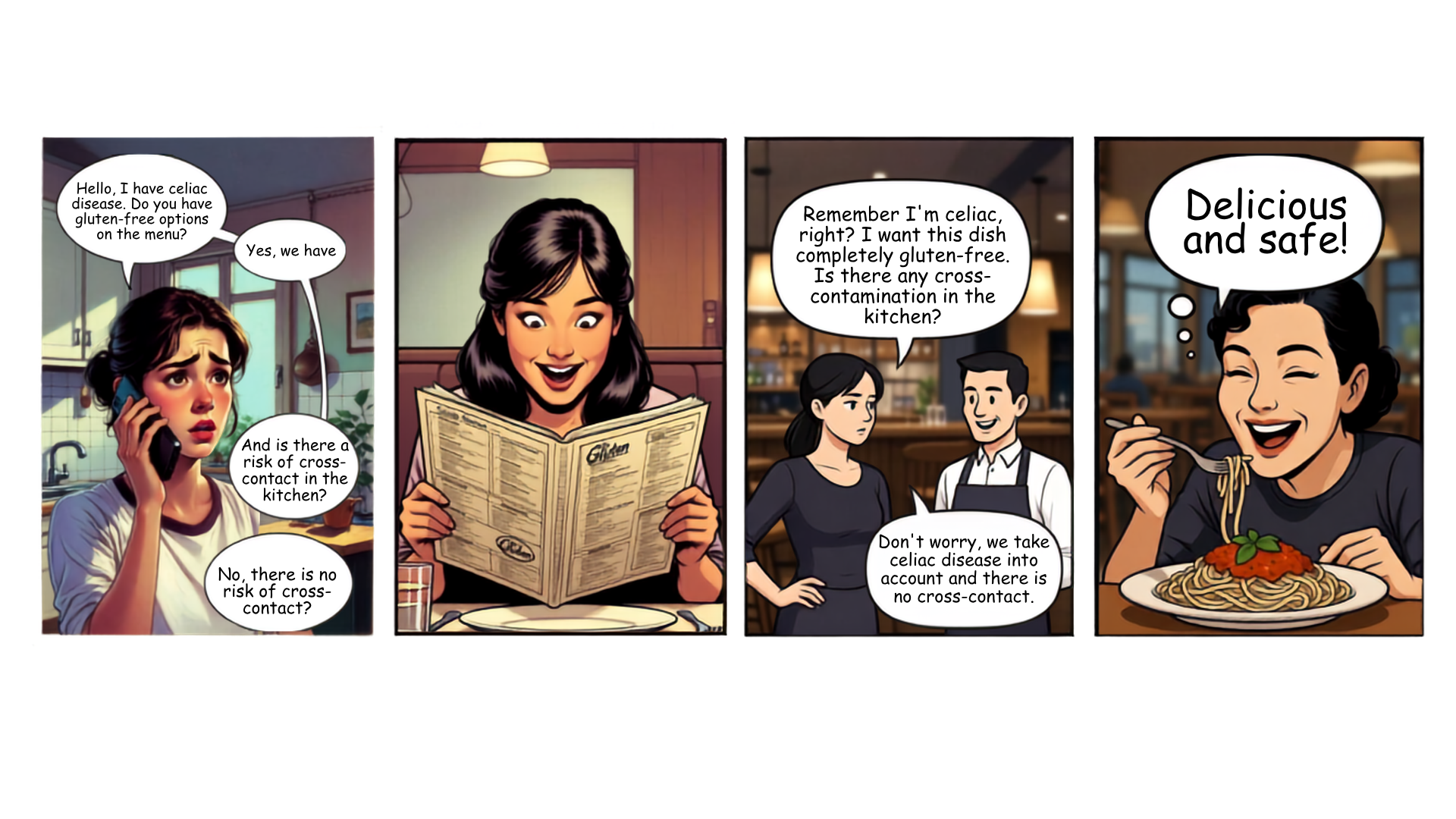
Eating out is one of the most challenging experiences for someone with celiac disease. Therefore, when dining at a restaurant, it's advisable to:
- Choose a certified establishment that is listed with the Catalan Celiac Association. Whenever possible, make a reservation in advance and ask by phone how they prepare gluten-free products, avoiding cross-contact.
- Upon arrival, it is necessary to identify yourself as a celiac person even if you are choosing the gluten-free options indicated on the menu.
- Don't hesitate to ask about the ingredients and the preparation process of the dishes.
- Ask the staff how they prepare them and the ingredients they use to find out if there is a risk of cross-contact.
- In the case of celebrations (weddings, baptisms, communions, etc.), it is advisable to be prepared and warn the organizers that a special diet is necessary.
The regulations only require the indication of allergens—including gluten—when they are used as an ingredient in a dish, but there is no obligation to indicate the risk of cross-contamination or the presence of traces, even if they are certain a dish contains them. Therefore, it is essential to always ask whether dishes labeled as "gluten-free" are also prepared without cross-contamination.